|
EC
John Ruskan's
Emotional Clearing
Working On Yourself
the
book
> testimonials
> reviews
> table of contents
emotional
clearing
guided process cd
alphajourney
cd
yoga
connection
|
  |
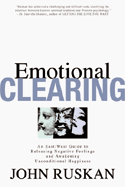
Emotional Clearing by John Ruskan
reviewed by:
Derek Cameron for Yoga Journal
Boz Martyn
Reviewed by Derek Cameron for Yoga Journal
The Mat and the Couch
From his own hands-on experience with both Eastern and Western traditions,
New York psychotherapist John Ruskan has come up with a pragmatic
synthesis of Eastern spiritual practices and Western psychotherapy.
In addition to his formal academic training in psychology, Ruskan
undertook practical training in, yoga, first with Yogi S.A. Ramiaah
and later with Yogi Amrit Desai, founder of the Kripalu ashram. Ruskan's
principal conclusion from his extended period of practice is that
spiritual endeavors will succeed only if they are firmly based on
the nitty-gritty work of dealing with suppressed emotions. Ruskan
believes-as do proponents of Arthur Janov's primal therapy movement
and the many contemporary breathwork and rebirthing schools-that the
essence of inner work consists of freeing suppressed, painful emotions.
In order for full healing to take place, these difficult feelings
must first be brought into awareness, then accepted and loved, and
finally integrated into the individual's consciousness.
For Ruskan, an important technique for achieving this integration
is a form of connected breathing that he learned, under the name kriya
yoga, from his teacher S.A. Ramiaah. In Ruskan's approach to psychotherapy,
this conscious, connected breathing is continued until a cathartic,
healing release takes place. Ruskan's book gives detailed instructions
for carrying out this breathwork, together with instructions for a
few key visualization exercises.
Ruskan further recommends the use of certain yoga asanas as tools
for investigating and releasing emotional holding patterns. A few
simple postures-such as Seated Forward Bend and Headstand-are each
held for a period of one to five minutes, during which time the student
breathes easily and focuses on the feelings that come up. Ruskan selects
the recommended postures based on their connection with the chakras--
the energy "wheels" or centers within the body.
As in some forms of Buddhist vipassana meditation, Ruskan also advises
that the healthiest approach to dealing with emotions such as fear
or anger is simply to "be with" them. In particular, he
counsels his clients to beware of their own attempts to intellectualize
away these difficult emotions. Even affirmations must be used with
care, since these, too, can become a further attempt to suppress difficult
and unwanted feelings.
Ruskan's book is full of useful insights into emotional healing, and
he deserves a wide audience among both psychotherapists and yogis
alike.
Derek Cameron has practiced yoga for almost three decades
and is a regular reviewer of books on psychological and religious
subjects.
Reviewed by Boz Martyn
In the last few decades, thousands of books have been published under
the banner of "Self-help/ Psychology." They are of widely
varying quality. Some are expressions of inspired guidance, such as
the works of Joan Borysenko, Jacqueline Small, and John Bradshaw.
Others are little more than oversimplified pastiches of pop psychology
that are useful only to a limited degree---Men Are From Mars, Women
are From Venus by John Gray springs readily to mind. Still others
are blatantly overhyped pieces of pure crappolla whose entire publication
run is not worth the death of single twig-please fill in your own
favorite in this category. Emotional Clearing definitely falls, or
ascends, into the realm of inspired guidance.
At first glance, however, there doesn't really seem to be anything
special about this book. After all, transpersonal psychologists have
been exploring the interface between psyche and spirit for some time,
influenced by the insights of pioneers such as Jung, James, Aggassoli,
and Houston. Can there really be a fresh approach to the subject?
The answer is "Absolutely!"John Ruskan covers a lot of the
same territory as earlier works, but he stakes his own indisputable
claim along the border between Eastern spirituality and Western psychology.
Ruskan's clarity in revealing the topography of this border to us
shows that it really is a path leading to self-understanding, transformation,
and spiritual growth.
"I can do this!" was the thought that sprang to mind as
I read the first chapter. A little further along I found that I was
no longer simply reading a book for the purpose of reviewing it for
this magazine. I was enrolled in its wonderfully holistic approach
and totally committed to the powerful and clearly defined model of
self-healing it presented.
The basic premise of Emotional Clearing is a simple truth: feelings
are to be felt. This may seem obvious, but it isn't always so. We
suppress many of our emotions and feelings--especially, but not exclusively
those considered negative. Not feeling them in the emotional centers
of our body is destructive to ourselves, and by extension, to the
world. To heal ourselves and the planet, we must learn to feel what
we feel. Ruskan explains that the subconscious is not just a place
where feelings "go." We actually create the field of subconscious
energies by suppressing powerful feelings, both negative and positive.
These are the psychological equivalent of karma.
In this subconscious form, these feelings can act like toxic waste
that poisons our mental processes, manifests illness in the body,
and blocks the highest expression of our true spiritual selves. By
extension, we see that the ills of the world are caused, in large
measure, by our not being who we really are.
The section dealing with projection is particularly enlightening.
According to Ruskan's model, we tend to see the energies we have suppressed
in other people, groups, or institutions. A person who has suppressed
sexual desires (potential energy seeking expression) may for example,
interpret an innocent touch from a sexually vital person as an uncalled-for
advance. An individual who has suppressed a need to control others
may see an effective and decisive leader as a "control freak."
The result is that our view of reality is skewed. We see the projected
energies as powers outside ourselves. The wisdom of The East reaches
us, however, that this is an illusion, albeit a very persuasive one.
In Ruskan's words, "You will appear to be entirely justified
in your blame. Even an impartial outside observer might agree that
you are contending with an outside force. The truth is that there
is no outside force."
In other words, as individualized focal points for the creative energies
of the Universe, we create our world, by projecting it outward from
individual consciousness onto the field of possibilities "outside."
This field, which Deepak Chopra calls a "quantum soup,"
takes on the apparently solid forms of whatever we see into it. So
projection goes on all the time, each of us cocreating our own localized
version of our shared reality. And for each of us, at least until
we gain deeper understanding of this process, the reality we perceive
is the only game in town.
Much information in this book concerns the chakras, auras, karma,
past lives, breathwork, yoga, and affirmations. All of these are presented
in a format that reveals progressive steps for recognizing our emotions,
feeling them in the body, observing their energy patterns, and then
processing and integrating them as parts of the whole that is our
true self. In the process, the negative psychic toxins are released,
along with the addictions and delusional perceptions that they have
fed into.
This healing modality is called Integrative Processing Therapy. Ruskan
began to develop it after a profound experience that occurred during
a Yoga exercise.While holding a particularly difficult posture, The
Mountain, he found that intense energies were moving in his body.
After releasing the pose, he began to move around the room. In his
words: "As I moved, I suddenly began to sense the energy in my
body. The energy was taking the form of classical ballet positions
I could not name...drawing my body into as close a correspondence
as possible. The inner seeing and feeling of the energy taking the
archetypal ballet position, the realization that the positions were
indeed archetypal, and the ecstasy from the inner perception were
all overwhelming. I was taken through a beautiful and moving artistic
experience."
Ruskan was a musician. Though he had a natural aptitude for dance,
he had no formal training. He had assumed that he might have been
a dancer in a past life, but had never done any work around that intellectual
assumption. Prior to this experience, he had been grappling with the
sorts of issues that many artists face, primarily centered around
the dichotomy between the need to be creatively expressed and the
need for acceptance--a need that seems to necessitate tailoring your
work to the perceived demands of the marketplace.
By yielding to this impulse, Ruskan entered into a destructive cycle
that did not allow his true self to be expressed in his art, and he
was suppressing his true creative energies. These energies were then
projected into in their most negative form onto a world that in turn
seemed to be growing increasingly cold and hostile. He became very
bitter and isolated, from others as well as his own creative center.
The experience of the spontaneous ballet postures was a major catharsis
for him, and he was able to understand that it was the release of
suppressed energies-apparently from a past life also filled with the
pain and frustration of thwarted potential--and that it signaled the
beginning of true healing.
He began to see the dualistic nature of his artistic expression: the
ecstasy of the creative process and the agony of the isolation and
emptiness brought about by depleted energies. He saw that they were,
like all dualities on this plane of being, complementary parts of
a whole experience. He was then able to fully experience his pain
directly, in his body, and to integrate the poles of his artistic
expression. In the process, he removed the negative charge from his
projections into the world of forms and individualities. He was also
able to move beyond self-rejection, to learn to love and accept himself
and others, and to experience unconditional happiness. The healing
that resulted led to his further development of this process, as set
forth In Emotional Clearing.
In addition to being an artist and spiritual seeker, Ruskan is a psychotherapist.
He brings these callings to bear in this work to produce a highly
creative synthesis of healing processes for mind, body, and spirit.
Helpful charts in the book illustrate techniques for strengthening
the aura and entering the "Witness Consciousness" through
meditation. A table shows the correspondences of the chakras to the
planetary bodies, and the book has helpful advice on using astrology,
not as a system of divination, but as a kind of psychic road map,
showing the routes that our energies are likely to take. This book
succeeds brilliantly in its stated intention of integrating these
concepts with the language and methodology of western psychology.
The clarity of focus and the sheer practicality of its approach make
this a work deserving of a wide audience.
I would recommend Emotional Clearing for anyone committed to true
healing-for yourself, for others, and for the planet. It presents
a holistic model of human consciousness and a workable plan for eliminating
impediments to optimal mental health and a heightened quality of life.
Its implementation should not conflict with professional therapy and
would likely be approved by any therapist or counselor who is open
to a transpersonal approach. Their numbers are growing steadily as
we approach the New Millennium.
Those of us who undertake this work will surely gain new insights
into the way that we cocreate our reality and the curious deceptions
that we are capable of perpetrating upon ourselves when we block our
feeling nature. That alone would make it worthwhile. But John Ruskan
goes much further, showing us a sure way out of the grotesque funhouse
minor-maze of projected illusion. And the way out is also the way
in-through the feeling nature to the heart of peace, the wondrous
divine beingness that is our true Self.
Boz Martyn is co-director,with his wife Sunny Hepler-Martyn,
of Light of Creation, Inc. And, he adds, "Namaste, Y'all"
|
|